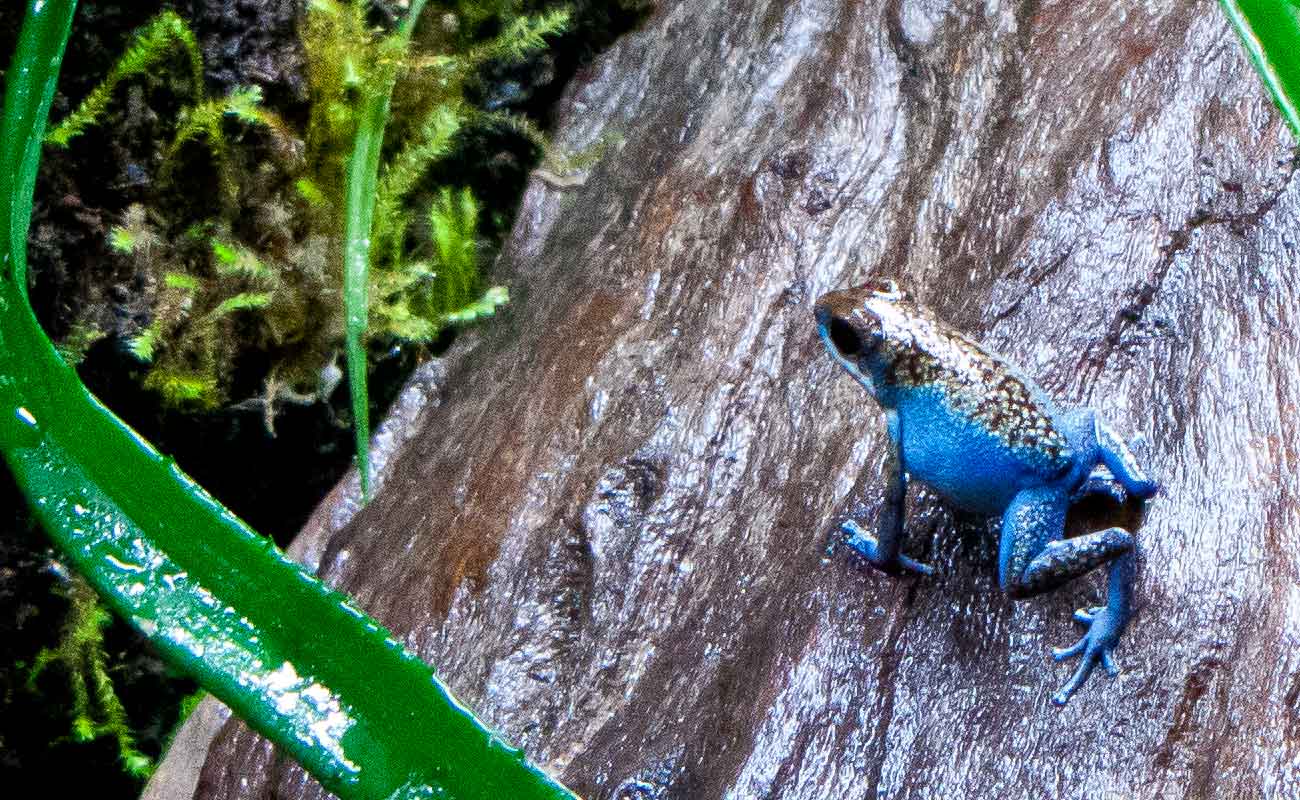
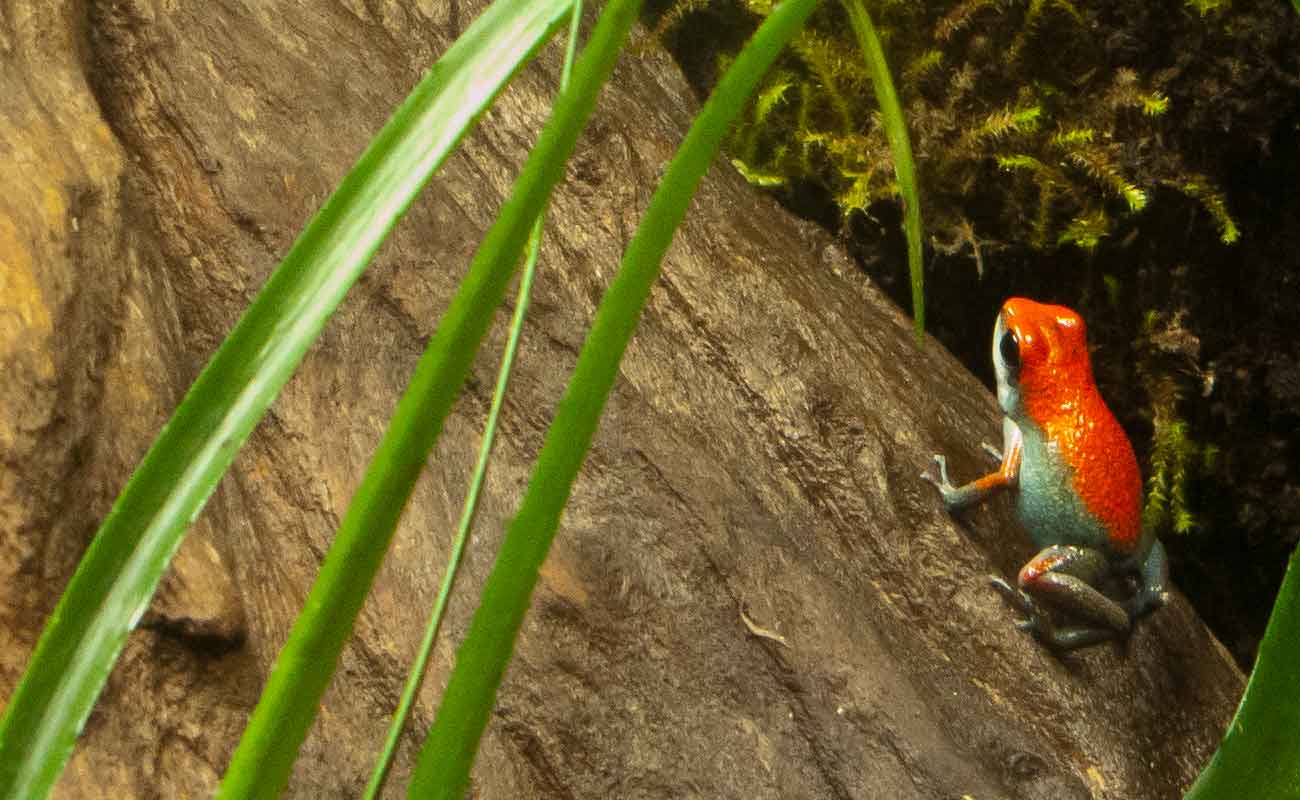
Ranitomeya amazonica (Schulte, 1999)

These inhabitants of primary and secondary forests are ranked as “data deficient” (DD) on the Red List. They are believed to live in the Amazon Basin from Iquitos in Departamento Loreto, Peru, to the eastern Guayana Shield. However, this species is reliably confirmed only for a restricted area of about 70 km around Iquitos, at about 120 m a.s.l.. The surroundings of Iquitos, marked by many patches of white sand, provide so little nutrition that forests are limited to sparse stands of stunted trees. The resultant great intensity of light reaching the ground enables large numbers of bromeliads to grow on the floor. These so called “varillales” are the natural habitat in which both R. amazonica and R. reticulata are regularly found on the ground. This species is also presumed to make use of epiphytic bromeliads, living as a tree-dweller in these situations.
The females grow to reach 18 mm, while the males are only slightly smaller. Their basic color is black, with a contrastive yellow to orange red pattern. At the level of the anterior margins of the eyes begin the upper edges of a Y on the back, formed by the black component of the pattern, while its marking ends at the cloaca. Occasionally, one of the upper shanks of the figure Y may be separated from the other two. Some specimens often have a black spot just above the snout and sometimes a yellow or orange red ventrolateral stripe, which is delimited ventrally with black. The frog’s black flanks are sometimes laced with a lighter pattern while the ventral side and limbs are bluish to greenish, dotted with black. The yellow to orange lower side of the head has large black blotches on the lateral margins of the throat and medially in front of the collar bone.
A typical characteristic is the male’s humming call that can be heard clearly right after a misting session.
R. amazonica feed on springtails, aphids, fruit files, tiny crickets, firebrats, white woodlice, etc. For keeping at home a spacious terrarium of the Type I is most suitable in which the bromeliad vegetation should partition the tank into several minor stories. As spawning sites one can use black film containers that are mounted at various levels of the terrarium and should always be kept slightly moist.
This species of frogs, that is fairly agile but tends to become quite tame with time, has probably been relatively long kept and propagated in terraria but was regarded only as a color variety of R. ventrimaculata.
These frogs are best kept in pairs or smaller groups in spacious terraria where the temperatures vary from 25 to 27˚C. It is of high importance to maintain high levels of relative humidity for their successful propagation. Another precondition is also frequent misting, along with some bromeliads and film containers that are half filled with water and ought to be present around the mid-level of the terrarium.
Raising the eggs or subsequent tadpoles artificially is easy. The latter are namely highy cannibalistic and therefore need to be raised in isolation and fed a diet that includes fish food, mosquito larvae, etc. and should be as varied as possible.
Moving the froglets from their original terrarium during their first two months is not advisable since they respond very badly to stress of any kind in this early period. They mature at an age of 9-12 months.
Representatives of the yellow and orange red forms interbreed under the conditions of a terrarium. Captive breeding is also known to have produced bastards between R. amazonica and R. reticulata, whis is surprising as both species occur syntopically in nature. Also known are hybrids R. amazonica x R. variabilis.
Ranitomeya imitator (Schulte, 1986)

In this frog species, listed as “least concern” (LC) on the Red List, two forms are distinguished on the basis of their more or less constant color patterns and different distribution ranges, whereas a third, intermediate, form is highly variable.
The highland form inhabits moist premontane forests, not only primary, but also secondary forests, the margins of plantations and even parts along roads. These areas are usually at 550 m a.s.l., where average temperatures vary between 22 and 26˚C and sometimes decrease to as low as 17˚C. A tree-dwelling highland form is known, usually perched at 0.5-1.5 m above the ground on vegetation, which can be found on the ground only occasionally but can live on trees up to heights of 8 m.
The highland R. imitator lives in Cordillera Oriental in the east of the Departamento San Martín, Peru, at 250-1,000 m a.s.l..
The lowland form of this species can be found in primary forests and forest remnants of a more secondary character, where it inhabits lower vegetation up to heights of 1.5 m above the ground, but is also commonly living on the ground. In such places the temperatures rage from 26 to 30˚C during the day, and around 22˚C at night.
This form lives in lowlands to either side of the Río Huallaga, at least from Shucushyacu to the Río Paranapura in Departamento Loreto, Peru, at 160-300 m a.s.l., then further north to Jeberos.
Another form, the so-called fantastica form, is known to inhabit areas similar to the natural habitat of the lowland form, with slightly lower temperatures. These areas include the passage of the Río Huallaga in the Departamento San Martín in Peru, at around 200 m a.s.l..
The highland form of R. imitator resembles in its exterior R. variabilis. The ground color of the upper side is light yellowish, yellowish orange, greenish or bluish, with large black spots that may be fused to form an almost stripped pattern. The resulting light interspaces are already an intermediate character, linking it to other forms. A typical specimen also has two black dots that the nostrils on the snout, which is a known distinctive feature that also led to the name “two dots” for respective frogs and permits (in most cases) to differentiate them from the very similar “one dot” (R. variabilis). The frog’s ventral side can be light gray to bluish, usually yellowish at the throat and the black spots are somewhat smaller than those on the back. Some irregular black dots can also be seen on the gray, bluish or greenish limbs.
The lowland R. imitator has black sides and back with five, usually regular longitudinal median lines in yellow or orange extending from the tip of the snout, dorsolaterally from the anterior margins of the eyes, and ventolaterally as a continuation of a supralabial stripe that extends to the armpit and on from there. These five lines are commonly linked on the snout right before the eyes by a crossbar. Both limbs and the ventral side of the body are light blue with some irregular, small, black dots. The throat can be either yellow or orange with black dots.
The fantastica form of R. imitator is very similar to R. fantastica, with the upper and lower sides black and an orange to light copper-colored pattern, often light gray on the limbs. More or less regularly shaped bands and stripes mark the dorsal side, whereas the stripes are often wide and so reduce the black background to mere spots. Lines on the limbs usually twist or form a reticulated configuration. The ventral side is very coarsely marbled with black and orange and there are five, usually not quite regularly shaped longitudinal lines ventrolaterally, dorsolaterally and medially. The limbs can be bluish with some irregular black spots.
Because the males are often aggressive towards each other, it is highly advisable that this species should only be kept in pairs in a spacious rainforest terrarium of the Types I or IV, or also Type V. Its bromeliad vegetation should divide the tank into numerous stories, while the always slightly moist black film containers, mounted at various levels in a horizontal or slightly oblique position pointing to the rear, are accepted as spawning sites. The maximum day temperatures should take into account the origin of the frogs, frequent misting and a high level of relative humidity are preconditions for successful breeding. This species feeds on aphids, springtails, fruit flies, firebrats, white woodlice and the smallest of crickets.
Mainly because of its uncomplicated propagation and its interesting behavior, R. imitator ranks among the most recommendable poison frogs for the terrarium.
Dendrobates for sale
Species with the price is available. Species without prices are currently not in stock / sales. Please contact me for further questions / reservations.
Ranitomeya amazonica

Price: 40 €
Size: XL
Remarks: I accept the booking
Ranitomeya ventrimaculata

Price: 30 €
Size: XL
Remarks: I accept the booking
Dendrobates list
- Ranitomeya vanzolinii (Myers, 1982)
- Ranitomeya tolimensis (Bernal, Luna-Mora, Gallego & Quevedo, 2007)
- Ranitomeya summersi (Brown, 2008)
- Ranitomeya sirensis (Aichinger, 1991)
- Ranitomeya dorisswansonae (Rueda-Almonacid, Rada, Sánchez-Pacheco, Velásquez-Álvarez & Quevedo, 2006)
- Ranitomeya defleri (Twomey and Brown, 2009)
- Ranitomeya daleswansoni (Rueda-Almonacid, Rada, Sánchez-Pacheco, Velásquez-Álvarez & Quevedo-Gil, 2006)
- Ranitomeya benedicta (Brown, 2008)
- Ranitomeya ventrimaculata (Shreve, 1935)
- Ranitomeya variabilis (Zimmermann & Zimmermann, 1988)
- Ranitomeya uakarii (Brown, Schulte & Summers, 2006)
- Ranitomeya reticulata (Boulenger, 1884, “1883”)
- Ranitomeya lamasi (Morales, 1992)
- Ranitomeya flavovittata (Schulte, 1999)
- Ranitomeya fantastica (Boulenger, 1884)
- Ranitomeya duellmani (Schulte, 1999)
- Ranitomeya biolat (Morales, 1992)
- Ranitomeya virolinensis (Ruiz-Carranza & Ramírez-Pinilla, 1992)
- Ranitomeya viridis (Myers & Daly, 1976)
- Ranitomeya opisthomelas (Boulenger, 1899)
- Ranitomeya minuta (Shreve, 1935)
- Ranitomeya fulgurita (Silverstone, 1975)
- Ranitomeya claudiae (Jungfer, Lötters & Jörgens, 2000)
- Ranitomeya bombetes (Myers & Daly, 1980)
- Ranitomeya altobueyensis (Silverstone, 1975)
- Ranitomeya abdita (Myers & Daly, 1976)
- 1. Dendrobatidae: Dendrobatinae – The genus Ranitomeya (Bauer, 1988)


